The Three-Act-Structure is used for many conventional films that make the most out of it's protagonist's triumphs after his adversities. Here in the comedy cult classic, "The 'Burbs", I will examine how screenwriter Dana Olsen and director Joe Dante used this to perfection.
In Act I, it is established that season suburbanite Ray Peterson (Tom Hanks) has quite unusual neighbors, the Klopeks.. They never go outside, mow their lawn or take care of their house. Rumors circulate as to what they eat and what happened to the previous owners, the Knapps. The plot point or "mini-clmax/peak" of the first act is when Ray, along with a portly and highly imaginative neighbor, Art, and a disgruntled Vietnam vet, Rumsfield, see one of the "huns from the cave" viciously slam their garbage into their garbage can after driving it down from their house in a thunderstorm. Soon they all realize, their neighbors are more than meets the eye...
In Act II, it is established that an old retired ma down the street, Walter, has gone without a trace. Since the three neighbors are worried for his safety from the Klopeks, they actually break into his house and see "signs of a struggle" including Walter's toupee. Now surely the neighbors have kidnapped him and are eating him right now! So in effect the wives of the three men set up dinner with the Klopeks and what ensues is a hilariously awkward affair, until Rumsfeld finally brings up the missing Walter and Ray panics (the second plot point/peak), runs away and opens the door for the Klopeks dog which causes mayhem through the house. The neighbors regroup and Ray agrees with the wives that the Klopeks are really just eccentric people. But secretly Ray brings Art and Rumsfield together and show him Walter's toupee which he found in the Klopek's house! So the next day they prepare an assault on the premises...
Act III consists of the three neighbors breaking into the Klopeks house while the Klopeks are out of town. They look everywhere from the backyard until they reach the basement. But at night the Klopeks (and more importantly, their wives) return and see what they have done: they accidently hit a gas line and blew up their house! Then the police come and give logical explanations to who the Klopeks are (respected doctor) and what happened to Walter (a heart attack but now recovered). So all is over for our "heroes" until, while Ray is in an ambulance to the hospital, Mr. Klopek tries to kill him (third plot point/peak)! Then Ray fights and is able to prove that they had intended to take Walter (the wig) and killed the Knapps (a trunkful of skeletons are in the back of their car). So they were right and Ray returns home with his wife and kid in tow...
This is one of my favorite movies and everyone should see it.
Sunday, October 31, 2010

Friday, October 22, 2010
Blog Post: TV sitcoms
An aspect of the TV sitcom that Colin Tate talked about in class was the way the characters developed or didn't develop in the series. Sense a sitcom does not usually have an arc to the stories, it relies on casual viewership. This means the characters in the show usually go through some comically tough situations, but their overall demeanor, views, and personality remain the same throughout the series.
Characters in a sitcom rely on their consistency to draw laughs from an audience. It is because of their relentless consistency to their ideals even in the face of a life-changing moment that makes them comical, but not sad at all.
Take the character of George Costanza in the best show (let alone sitcom) ever made, "Seinfeld". George is a compulsive liar, who has no regard for anyone in the world other than himself. So why do we as an audience not only find him hilarious, but the driving comic force of the show? Simply because no matter what happens, no matter how severe the consequences, no matter how much dignity he loses, he never changes. He is steadfast to his ideals and remains the same pathetic, unlikeable, yet strangely endearing and gut-bustingly funny loser he always is.
Characters in a sitcom rely on their consistency to draw laughs from an audience. It is because of their relentless consistency to their ideals even in the face of a life-changing moment that makes them comical, but not sad at all.
Take the character of George Costanza in the best show (let alone sitcom) ever made, "Seinfeld". George is a compulsive liar, who has no regard for anyone in the world other than himself. So why do we as an audience not only find him hilarious, but the driving comic force of the show? Simply because no matter what happens, no matter how severe the consequences, no matter how much dignity he loses, he never changes. He is steadfast to his ideals and remains the same pathetic, unlikeable, yet strangely endearing and gut-bustingly funny loser he always is.
Sunday, October 17, 2010
Blog Post: Different shots/angles example
In lecture last week we learned about different shots and their literal and emotional purpose. The long, medium, and close-up shot are used everywhere, but my example comes from the show "Lost".
In the series finale, the final shot is of monumental importance to the show. It shows that our hero, Jack has saved the island and the original castaways left safely thanks to his efforts. When Jack is about to die and and enter a heaven with his fellow castaways in a purgatory for them all, the final shots show the beauty of his sacrifice.
At first there is a long shot of Jack finally crumbling to the ground after walking through the jungle mortally wounded. The long shot is a sad one representing isolation and loneliness. It does this to perfection.
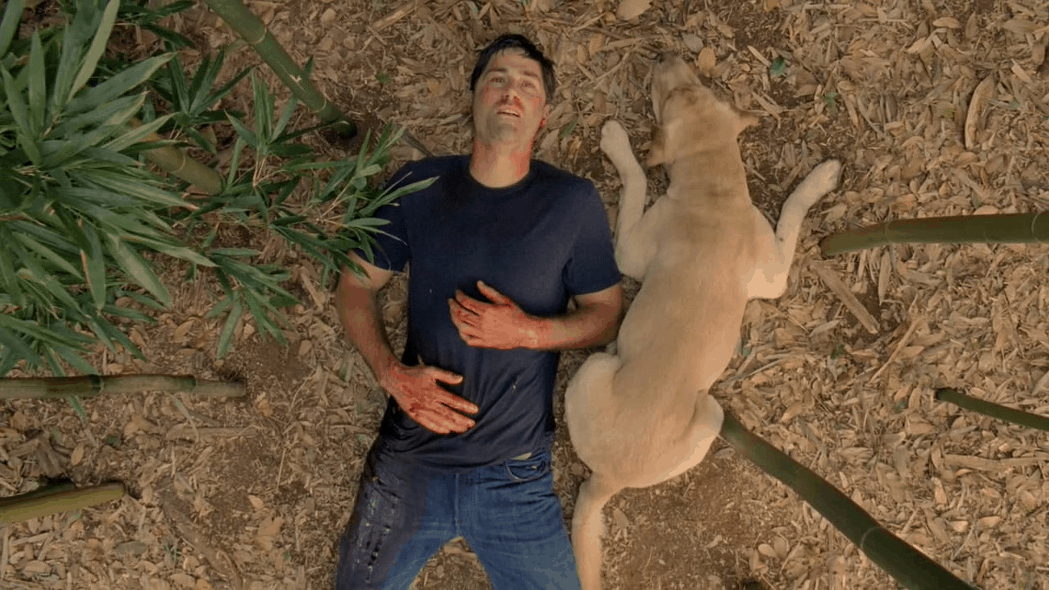
Then they employ a medium shot of Jack to show the information that Jack is dying but he is not sad as the long shot implied. He is satisfied to know his purpose in life has been fulfilled and happy to see that his friends are safe.

Then the last shot of the show is a close-up which shows Jack's eye with a tear forming. From this close-up, we see that our initial perception from the long shot about Jack was wrong. He is not lonely our isolated as we feared. He is overwhelmingly happy and reflective on what he has done for the island and what the island has done for him, changing his life to see more than himself and his place in the world. As we have seen in the purgatory flash-sideways, we know this isn't the end for Jack, just the beginning of something new and wonderful that he sees too.

With that sense of closure, Jack can finally die in peace. He knows that there is more than just this and also that he has done what his destiny foretold, and changed his life in the process. His eye closes on another close-up for emotional impact signaling the end of Jack and "Lost" as a whole...

Great stuff...
In the series finale, the final shot is of monumental importance to the show. It shows that our hero, Jack has saved the island and the original castaways left safely thanks to his efforts. When Jack is about to die and and enter a heaven with his fellow castaways in a purgatory for them all, the final shots show the beauty of his sacrifice.
At first there is a long shot of Jack finally crumbling to the ground after walking through the jungle mortally wounded. The long shot is a sad one representing isolation and loneliness. It does this to perfection.
Then they employ a medium shot of Jack to show the information that Jack is dying but he is not sad as the long shot implied. He is satisfied to know his purpose in life has been fulfilled and happy to see that his friends are safe.
Then the last shot of the show is a close-up which shows Jack's eye with a tear forming. From this close-up, we see that our initial perception from the long shot about Jack was wrong. He is not lonely our isolated as we feared. He is overwhelmingly happy and reflective on what he has done for the island and what the island has done for him, changing his life to see more than himself and his place in the world. As we have seen in the purgatory flash-sideways, we know this isn't the end for Jack, just the beginning of something new and wonderful that he sees too.
With that sense of closure, Jack can finally die in peace. He knows that there is more than just this and also that he has done what his destiny foretold, and changed his life in the process. His eye closes on another close-up for emotional impact signaling the end of Jack and "Lost" as a whole...
Great stuff...
Friday, October 8, 2010
Blog Post: Ol' Hollywood's Studio System
In the "Golden Age" of Hollywood from the 20's through the forties and really until the 50's, Hollywood practiced the "studio system" in which one studio would controlled all aspects of the production and every person involved. With this system it was easy to pump out seven movies a year with one major star since the studio owned what they would do, and usually it was the same type of movie every time. Maybe the biggest factor in his system, and what I found most interesting, was their use of movie stars and how they limited them to a certain type of film.
As Colin Tate said in his lecture, sometimes stardom trumps genre. Stars like Humphrey Bogart, Gene Kelly, and Errol Flynn had very specific roles to play in this studio system. Bogart would evolve into almost always playing the hard-boiled, morally questionable, but in the end, heroic good guy. This meant he he did a slew of detective movies which placed him in this role and the studio of Warner Bros. became known for their noir and detective movies. Kelly was always placed as a leading man in musicals which involved heavy dancing as well. MGM therefore, put out many musicals and much of them had Kelly doing this role over and over. Flynn became a staple for heroic action pictures and was a very big draw for the swashbuckling pictures of 20th Century Fox. The star power of these three people ended up helping the studios create what kind of genre films they would produce.
To show how these stars shaped their studios and genres let's look at movies where they played against type. When Humphrey Bogart played a villainous gold seeker (and gave his best performance) in John Huston's "The Treasure of the Sierra Madre", the film was a commercial and critical flop. Despite winning three Oscars, the film was not regarded as a classic until many years later. Kelly played a brutally cynical and miserable journalist in Stanley Kramer's "Inherit the Wind" and was not given much credit for his performance when released. It is now looked upon as one of his finest. Flynn probably is the best example, playing a self-pitying (though sympathetic) drunk in Henry King's "The Sun Also Rises". This impressive character turn for Flynn was very against type and the film proved to be a flop as well. Yet now it is regarded as truly his best performance.
What is described above shows how stars shaped what audiences expected out of their studios. They wanted a detective story, a showy musical, or a swashbuckling thrill but when these actors tried something different, it proved detrimental to their studios. Bogart could not play a villain at the height of his popularity. Kelly could not have purely dramatic role. Flynn could not play a drunk. The stars made the studio system, yet it provided very little freedom to show their skills and only years later can we fully appreciate the different roles they tried to do.
As Colin Tate said in his lecture, sometimes stardom trumps genre. Stars like Humphrey Bogart, Gene Kelly, and Errol Flynn had very specific roles to play in this studio system. Bogart would evolve into almost always playing the hard-boiled, morally questionable, but in the end, heroic good guy. This meant he he did a slew of detective movies which placed him in this role and the studio of Warner Bros. became known for their noir and detective movies. Kelly was always placed as a leading man in musicals which involved heavy dancing as well. MGM therefore, put out many musicals and much of them had Kelly doing this role over and over. Flynn became a staple for heroic action pictures and was a very big draw for the swashbuckling pictures of 20th Century Fox. The star power of these three people ended up helping the studios create what kind of genre films they would produce.
To show how these stars shaped their studios and genres let's look at movies where they played against type. When Humphrey Bogart played a villainous gold seeker (and gave his best performance) in John Huston's "The Treasure of the Sierra Madre", the film was a commercial and critical flop. Despite winning three Oscars, the film was not regarded as a classic until many years later. Kelly played a brutally cynical and miserable journalist in Stanley Kramer's "Inherit the Wind" and was not given much credit for his performance when released. It is now looked upon as one of his finest. Flynn probably is the best example, playing a self-pitying (though sympathetic) drunk in Henry King's "The Sun Also Rises". This impressive character turn for Flynn was very against type and the film proved to be a flop as well. Yet now it is regarded as truly his best performance.
What is described above shows how stars shaped what audiences expected out of their studios. They wanted a detective story, a showy musical, or a swashbuckling thrill but when these actors tried something different, it proved detrimental to their studios. Bogart could not play a villain at the height of his popularity. Kelly could not have purely dramatic role. Flynn could not play a drunk. The stars made the studio system, yet it provided very little freedom to show their skills and only years later can we fully appreciate the different roles they tried to do.
Sunday, October 3, 2010
Blog Post: "All in the Family" Comparisons
Even when it premiered in America in the 1970's, audiences knew that "All in the Family" was a groundbreaking television show, pushing the boundaries of what a family oriented situational comedy could be. This influence has now passed on forty years later with our generation's new, edgy, and very popular sitcom, "Modern Family".
After seeing a few episodes of "All in the Family" and seeing every episode of "Modern Family", it is easy to draw parallels in the content both covered. They both deal with an older, traditional father (Carroll O'Connor and Ed O'Neill respectively) who must deal with the new radical changes, their adult children and younger generation feel. Archie (O'Connor) and Jay (O'Neill) both come face to face and resent new changes such as homosexuality, new, more loving ways of parenting (not just the "tough love" approach they grew up with), and the new roles men in society should take. Archie and Jay are both the dominant Alpha Male, and seeing their sons and sons-in-law take new, somewhat domestic roles shakes their sense of masculinity even more.
Where they differ however, is what makes the shows very different. Archie is a bigot, racist, sexist, and all around son-of-a-bitch whose mind is incapable of being changed. "All in the Family" usually ends with a prominent does of cynicism, following Archie's bewildered expression into no real impact, offering little hope for the older generation's understanding of new, liberal ideals. Jay, on the other hand, usually learns a lesson or two and "Modern Family" itself offers a more optimistic view of how family can come together and love each other even with so many generational differences. This is the true difference of the show, and what makes "All in the Family" a more cynical, topical show, and "Modern Family" a friendlier, if just as topical show.
As for the content, "All in the Family" had very edgy episodes showing a high-class African-American family richer than Archie's, the Jeffersons. This was very edgy and topical, but today is not very unusual or edgy on TV. For "Modern Family", the most relevant topic is a homosexual couple, raising a child. This is still VERY controversial and something that is true to our time. A concept like this was probably never even considered when "All in the Family" aired.
It is safe to say that without "All in the Family" we could not have new edgy, family shows like "Modern Family", "Family Guy", "The Simpsons", and most of all "South Park", the most relevant and revolutionary family comedy show of our generation. "All in the Family" made it possible to show very edgy social and political changes on a medium meant for safe, family comedy. Thank you, Norman Lear.
After seeing a few episodes of "All in the Family" and seeing every episode of "Modern Family", it is easy to draw parallels in the content both covered. They both deal with an older, traditional father (Carroll O'Connor and Ed O'Neill respectively) who must deal with the new radical changes, their adult children and younger generation feel. Archie (O'Connor) and Jay (O'Neill) both come face to face and resent new changes such as homosexuality, new, more loving ways of parenting (not just the "tough love" approach they grew up with), and the new roles men in society should take. Archie and Jay are both the dominant Alpha Male, and seeing their sons and sons-in-law take new, somewhat domestic roles shakes their sense of masculinity even more.
Where they differ however, is what makes the shows very different. Archie is a bigot, racist, sexist, and all around son-of-a-bitch whose mind is incapable of being changed. "All in the Family" usually ends with a prominent does of cynicism, following Archie's bewildered expression into no real impact, offering little hope for the older generation's understanding of new, liberal ideals. Jay, on the other hand, usually learns a lesson or two and "Modern Family" itself offers a more optimistic view of how family can come together and love each other even with so many generational differences. This is the true difference of the show, and what makes "All in the Family" a more cynical, topical show, and "Modern Family" a friendlier, if just as topical show.
As for the content, "All in the Family" had very edgy episodes showing a high-class African-American family richer than Archie's, the Jeffersons. This was very edgy and topical, but today is not very unusual or edgy on TV. For "Modern Family", the most relevant topic is a homosexual couple, raising a child. This is still VERY controversial and something that is true to our time. A concept like this was probably never even considered when "All in the Family" aired.
It is safe to say that without "All in the Family" we could not have new edgy, family shows like "Modern Family", "Family Guy", "The Simpsons", and most of all "South Park", the most relevant and revolutionary family comedy show of our generation. "All in the Family" made it possible to show very edgy social and political changes on a medium meant for safe, family comedy. Thank you, Norman Lear.
Subscribe to:
Comments (Atom)